Sunday, 14 December 2014

University of Southern California held its fourth annual Community Bowl


USA NEWS CORP


University of Southern California held its fourth annual Community Bowl

14 December, 2014, U.S., USA NEWS CORP


University of Southern California held its fourth annual Community Bowl on Dec. 6 at El Sereno Middle School, in which over 140 student-athletes partnered with more than 300 El Sereno students to beautify the school, practice good study habits and play games.  The focus of the day was mentorship on behalf of the Trojans, as representatives from nearly every sport spent one-on-one time with the middle school students. The entire day was a success with the students completing over 30 projects ranging from mural painting to flower planting to school clean up. Some 140 USC student-athletes joined more than 300 El Sereno Middle School students Dec. 6 for USC's fourth annual Community Bowl. They beautified the school, shared good study habits and played games. Flowers, like all plants, need good soil in order to grow up strong and healthy. Regardless of whether you are planting your flowers in a pot or a garden, good soil is a must. Avoid soil that is heavy with clay, sand, or rocks, and that has a balanced pH near 7. Flowers need at least six inches of loose soil to start out growing in, so loosen up a top layer at least this deep.  Although flowers are typically easy to grow, they can’t be grown just anywhere. An area with too much direct sun or too much shade will be difficult for some flowers to grow in. Find a happy medium with a location that has sun and shade throughout the day.


USA NEWS CORP


You can share this News URL on Facebook or your Social Media Site/ blog.


Submit your News in Comment box> Join us as Journalist > News Content purchase > Corrections > Copyright > Place a Classified Ad > Sell Your Home > Sell Your Business > Commercial Real Estate Ads > Advertise with us > Recruitment & Career Ads > Franchising > Advertise Locally > Contact us > plojindexing@gmail.com

Researchers use of 3-D maps to depict genetic information

USA NEWS CORP


Researchers use of 3-D maps to depict genetic information

14 December, 2014, U.S., USA NEWS CORP

Researchers use of 3-D maps to create catalog of 10,000 folding loops, depicting genetic regulation.
loopglobule6051
Researchers have assembled the first high-resolution, 3-D maps of entire folded genomes and found a structural basis for gene regulation, a kind of “genomic origami” that allows the same genome to produce different types of cells. The research appears online Thursday in the journal Cell. 3-D map can help in comparisons of genetic information among different species. Rebah Nejah Jabbar Al - Gafari recevied Doctorate Research Award-2014 in Biotechnology on Characterization, Classification, Genomic Analysis and Establishment of Phylogenetic Tree among Local Isolates of Antibiotic Producing Streptomycetes. The research was supervised by Prof. Dr Mohammad A – K Ibrahim, Prof. Dr Sami A. Al – Mudhaffar and Prof. Dr. Falah A. Attawi from Al – Nahrain University. Similarly  AAAS reported An international team of researchers has sequenced the genomes of 45 avian species and created the most reliable tree of life for birds to date. Their new avian family tree helps to clarify how modern birds — the most species-rich class of four-limbed vertebrates on the planet — emerged rapidly from a mass extinction event that wiped out the dinosaurs about 66 million years ago.
A central goal of the five-year project, a collaboration among researchers at Harvard University, Baylor College of Medicine, Rice University, and the Broad Institute of Harvard and MIT, was to identify the loops in the human genome. Loops form when two bits of DNA that are far apart in the genome sequence end up in close contact in the folded version of the genome in a cell’s nucleus.
Researchers used a technology called “in situ Hi-C” to collect billions of snippets of DNA that were later analyzed for signs of loops. The team found that loops and other genome folding patterns are an essential part of genetic regulation.
“More and more, we’re realizing that folding is regulation,” said study co-first author Suhas Rao, a researcher at Baylor’s Center for Genome Architecture and a 2012 graduate of Harvard College. “When you see genes turn on or off, what lies behind that is a change in folding. It’s a different way of thinking about how cells work.”
Co-first author Miriam Huntley, a doctoral student at the Harvard School of Engineering and Applied Sciences (SEAS), said, “Our maps of looping have revealed thousands of hidden switches that scientists didn’t know about before. In the case of genes that can cause cancer or other diseases, knowing where these switches are is vital.”
Senior author Erez Lieberman Aiden, Ph.D. ’10, formerly a junior fellow in the Harvard Society of Fellows, is now assistant professor of genetics at Baylor and of computer science and computational and applied mathematics at Rice. Aiden said the work began five years ago, shortly after he and colleagues at the Broad Institute published a groundbreaking study introducing the Hi-C methodology for sequencing genomes in 3-D. “The 2009 study was a great proof of principle, but when we looked at the actual maps, we couldn’t see fine details,” Aiden said. “It took us a few years to get the resolution to a biologically usable level. The new maps allow us to really see, for the first time, what folding looks like at the level of individual genes.”
The work to refine Hi-C and produce full-genome maps with gene-level resolution continued when Aiden moved to Houston in 2013, established the Center for Genome Architecture at Baylor and joined the Center for Theoretical Biological Physics at Rice. Aiden, who earned his master’s degree in applied physics and Ph.D. in applied mathematics at SEAS, credited Huntley and Rao with leading the research effort.
In addition to the challenge of overhauling the Hi-C experimental design, the team faced significant computational hurdles.
“In 2009, we were dividing the genome into one-million-base blocks, and here we are dividing it into 1,000-base blocks,” said Huntley, who is Aiden’s student. “Since any block can collide with any other block, we end up with a problem that is a million-fold more complicated. The overall database is simply vast.”
Identifying the loops was yet another challenge.
“Ordinary computer CPUs [central processing units] are not well-adapted for the task of loop detection,” Rao said. “To find the loops, we had to use GPUs, processors that are typically used for producing computer graphics.”
Huntley said new methods were also developed to speed the data processing and reduce experimental “noise,” irregular fluctuations that tend to obscure weak signals in the data.
“We faced a real challenge because we were asking: ‘How do each of the millions of pieces of DNA in the database interact with each of the other millions of pieces?’” Huntley said. “Most of the tools that we used for this paper we had to create from scratch because the scale at which these experiments are performed is so unusual.”
The big-data tools created for the study included parallelized pipelines for high-performance computer clusters, dynamic programming algorithms, and custom data structures. Rao said the group also relied heavily on data-visualization tools created by co-authors Neva Durand and James Robinson.
“When studying big data, there can be a tendency to try to solve problems by relying purely on statistical analyses to see what comes out, but our group has a different mentality,” Rao said. “Even though there was so much data, we still wanted to be able to look at it, visualize it, and make sense of it. I would say that almost every phenomenon we observed was first seen with the naked eye.”
Through these methods, the team discovered a series of rules about how and where loops can form in the genome.
“If DNA were a shoestring, you could make a loop anywhere. But within the cell, the formation of loops is highly constrained,” said Rao. “The loops we see almost all span fewer than 2 million genetic letters; they rarely overlap; and they are almost always associated with a single protein, called CTCF.” CTCF is involved in regulation of the 3-D structure of chromatin, the building block of chromosomes.
“The most stunning discovery was about how CTCF proteins form a loop” said Eric Lander, a corresponding author on the paper. “Even when they are far apart, the CTCF elements that form a loop must be pointing at each other — forming a genomic yin and yang.” Lander is director of the Broad Institute, professor of biology at Massachusetts Institute of Technology, and professor of systems biology at Harvard Medical School.
Interestingly, the team found that the largest loops in the genome are present only in women. Huntley pointed out that “the copy of the X chromosome that is off in females contains gigantic loops that are up to 30 times the size of anything we see in males.”
The researchers also found that many of the loops present in humans are also present in mice, implying that these specific folds have been preserved over nearly a hundred million years of evolution.
“Our findings suggest that mammals share not only similar 1-D genome sequences, but also similar 3-D genome-folding patterns,” said Aiden.
Additional co-authors include Elena Stamenova, Ivan Bochkov, Adrian Sanborn, Ido Machol, and Arina Omer at Baylor. The research was supported by the National Science Foundation, the National Institutes of Health, the National Human Genome Research Institute, NVIDIA, IBM, Google, the Cancer Prevention and Research Institute of Texas, and the McNair Medical Institute.


USA NEWS CORP


You can share this News URL on Facebook or your Social Media Site/ blog.


Submit your News in Comment box> Join us as Journalist > News Content purchase > Corrections > Copyright > Place a Classified Ad > Sell Your Home > Sell Your Business > Commercial Real Estate Ads > Advertise with us > Recruitment & Career Ads > Franchising > Advertise Locally > Contact us > plojindexing@gmail.com

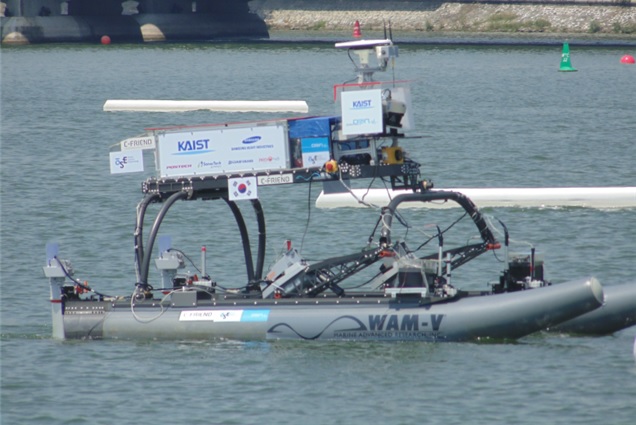
KAIST ranks 'Second' in Maritime RobotX Challenge

USA NEWS CORP


KAIST ranks 'Second' in Maritime RobotX Challenge
14 December, 2014, Singapore, USA NEWS CORP

The Journal of Sports and Physical Education emphasized to promote technology based sport competitions. These sports should be designed in such a way that they could serve the nation better. It would be nice approach if  these sports could harvest the application of new innovations. Recently KAIST took second place in an international competition to promote technologies of the autonomous underwater vehicle (AUV).

Professor Jin-hwan Kim’s research team from KAIST’s Ocean Systems Engineering Department won the second place in Maritime RobotX Challenge which took place for the first time from October 20 - 26 in Marina Bay, Singapore.

Along with automobiles and drones, the necessity for unmanned boats has grown. To encourage and examine the development of these technologies, the U.S. Office of Naval Research decided to organize an unmanned boat competition which took place for the first time this year.

After three teams were selected from a domestic competition in each countries, a total of fifteen teams from five countries from the Pacific Rim including Korea, the United States, Australia, Japan, and Singapore competed. Teams from such universities as MIT, Tokyo University, Tokyo Institute of Technology, National University of Singapore, Nanyang Technological University, and Queensland University of Technology participated. In addition to KAIST, Seoul National University and Ulsan University participated.

Using a 4.5 meters long and 2.5 meters wide unmanned boat provided by the organizer, each team had to implement an integrated system that combined a propulsion system, hardware, and autonomous software. Each team’s vessel had to perform tasks without manual control, employing autonomous driving through recognition of the course, searching underwater for acoustic sources, automatically approaching piers, remote observation of buoy, and avoidance and detection of obstacles.

Although KAIST outpaced MIT in the semifinal which selected six out of fifteen teams, it won the second place in the final. As well as winning second prize, KAIST also won best website prize and a special prize from the competition sponsor, Northrop Grumman Corporation, an American defense technology company, totaling 16,500 U.S. dollars of prize money.


The Vice President for Planning and Budget, Professor Seungbin Park said, “It was a great opportunity to showcase the advanced unmanned robot technology of Korea.” He added that “this raised KAIST’s reputation as a global research oriented university.”

Professor Kim commented, “Along with automobiles and drones, the necessity for the development of unmanned ocean vehicles such as unmanned boats and submarines are recognized these days.” He added that “the use of unmanned boats will make the process of channel investigation, ocean exploration, surveillance over water territories safer and more effective.”
Professor Kim’s team was sponsored by the U.S. Office of Naval Research, Samsung Heavy Industries, Sonar Tech, Daeyang Electric, and Red-one Technology. 


USA NEWS CORP


You can share this News URL on Facebook or your Social Media Site/ blog.


Submit your News in Comment box> Join us as Journalist > News Content purchase > Corrections > Copyright > Place a Classified Ad > Sell Your Home > Sell Your Business > Commercial Real Estate Ads > Advertise with us > Recruitment & Career Ads > Franchising > Advertise Locally > Contact us > plojindexing@gmail.com

ISRO's LVM 3 X flight is planned on December 18, 2014

USA NEWS CORP


ISRO's LVM 3 X flight is planned on December 18, 2014

14 December, 2014, India, USA NEWS CORP

Experimental flight of LVM-3 will carry active Solid boosters (S200s), Liquid core stage (L110) and a passive Cryogenic stage (C25).

The primary objective of this experimental flight is to validate the complex atmospheric ascent regime of this all new launcher, especially the aerodynamic and control features that cannot be conclusively tested on ground.

In this sub-orbital flight, the launcher would climb to an altitude of about 125 km. Taking advantage of this opportunity, a CARE (Crew-module Atmospheric Re-entry Experiment) Module is planned to be injected at this altitude. This module has been realized to validate a number of technologies developed under ISRO’s “Critical Technologies for Human Spaceflight Programme”. This Module is planned to be recovered from the Bay of Bengal after the splash down.


USA NEWS CORP


You can share this News URL on Facebook or your Social Media Site/ blog.


Submit your News in Comment box> Join us as Journalist > News Content purchase > Corrections > Copyright > Place a Classified Ad > Sell Your Home > Sell Your Business > Commercial Real Estate Ads > Advertise with us > Recruitment & Career Ads > Franchising > Advertise Locally > Contact us > plojindexing@gmail.com
Saturday, 13 December 2014

Geminid meteor shower


USA NEWS CORP


 Geminid meteor shower

14 December, 2014, USA, USA NEWS CORP

It's the most wonderful time of the year -- for spotting a Geminid meteor! The 2014 Geminid meteor shower is forecast to be a lively meteor shower with great views in the skies over Earth. The week of Dec. 8 is a good window for Geminid-watching, but the night of Dec. 13-14 is the anticipated peak. Best viewing will be in dark sky locations, away from city lights.
Geminids are pieces of debris from an object called 3200 Phaethon. Long thought to be an asteroid, Phaethon is now classified as an extinct comet. Basically it is the rocky skeleton of a comet that lost its ice after too many close encounters with the sun. Earth runs into a stream of debris from 3200 Phaethon every year in mid-December, causing meteors to fly from the constellation Gemini. When the Geminids first appeared in the early 19th century, shortly before the U.S. Civil War, the shower was weak and attracted little attention. There was no hint that it would ever become a major display. 
On Dec. 13, Cooke and a team of astronomers from Marshall Space Flight Center will host an overnight NASA web chat from 10 p.m. to 2 a.m. CST, answering questions about the Geminid meteor shower. The Geminids are expected to peak just before dawn on Dec. 14, with a predicted peak rate of 100 to 120 meteors per hour.


USA NEWS CORP


You can share this News URL on Facebook or your Social Media Site/ blog.


Submit your News in Comment box> Join us as Journalist > News Content purchase > Corrections > Copyright > Place a Classified Ad > Sell Your Home > Sell Your Business > Commercial Real Estate Ads > Advertise with us > Recruitment & Career Ads > Franchising > Advertise Locally > Contact us > plojindexing@gmail.com